MoArkNews.com
Feud on Main Street: How a Small-Town Arkansas Police Dispute Left a Disabled Veteran Jailed, Restrained, and Fighting for His Property Rights and Freedom
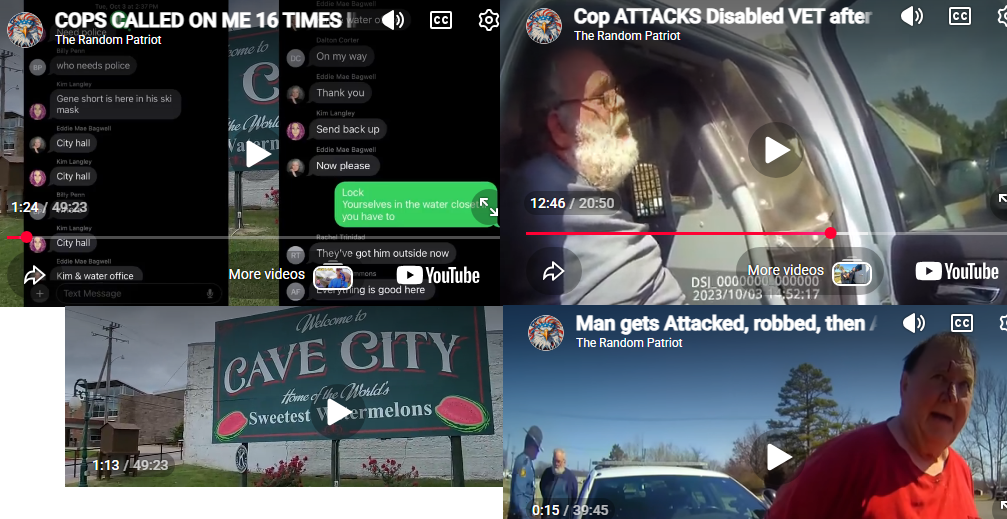
A bitter, multi-year conflict between the Cave City Police Department and 66-year-old disabled Veteran Gene Short has culminated in a firestorm of online backlash, severe allegations of selective enforcement, and a controversial property-line arrest igniting regional debates over constitutional freedoms on private land [Video 1 / 1:06, 1:17].
The saga—initially documented in a viral multi-part investigation by independent media outlet The Random Patriot—traces a line from a forceful arrest inside City Hall to a targeted physical ambush on private property along North Main Street [Video 1 / 0:46, 21:18].
Part I: The City Hall Confrontation
The public feud erupted into view when Short, an 82nd Airborne veteran and stroke survivor, walked into Cave City Hall with the express intent to file an official harassment complaint against Police Sergeant Trint Milligan [Video 1 / 1:13, 1:17, 2:24].
Rather than facilitating a meeting with the mayor or a departmental supervisor, as she alleged to Mr. Short she would, a front-desk municipal clerk bypasses standard protocol [Video 1 / 2:16, 6:31]. She issued a mass text message directly to all on-duty police officers [Video 1 / 6:39, 6:46]. Ironically, Sgt. Milligan was the very first officer to arrive on the scene to confront the citizen seeking to report him [Video 1 / 6:46].
Audio logs from the encounter capture the rapid escalation [Video 1 / 7:23]. Within seconds of entering the building, Milligan ordered Short to leave, giving the elderly veteran "two Mississippi" before initiating a forceful physical takedown inside the public hallway [Video 1 / 6:22]. Short, who has severe physical limitations due to his past stroke and shoulder damage, was thrown to the ground and handcuffed [Video 1 / 1:13, 8:37].
Short was jailed for three days, during which he suffered a mild medical emergency after being denied access to his prescribed medications. Upon his arraignment, Short was hit with charges of disorderly conduct and resisting arrest, placed on a strict suspended probation sentence, and permanently criminally trespassed from entering City Hall—effectively barring him from paying his local utility and water bills in person.
The Hidden Docket—A Secret Commitment and Waived Rights
While Cave City officials publicly processed Gene Short through standard misdemeanor charges, public court repositories from the Sharp County Circuit Court reveal a far more insidious administrative maneuver operating entirely behind closed doors.
Official judiciary records for Case Number 68PR-23-106: STATE OF ARKANSAS V. GENE SHORT reveal, on October 4, 2023, Sharp County Prosecuting Attorney Abraham Samuel Keefer filed a Petition for Civil Commitment against Short, officially designating the 63-year-old disabled veteran as "Incapacitated / Incompetent."
Short states he had absolutely no idea this case even existed—and the timestamps on the official docket prove why. The entire judicial system managed to open a case, sign a detention order, waive Short's constitutional rights, and close the file in a span of just 4 hours and 39 minutes.
(Note: The image chosen by The Random Patriot is not in the actual video.)
- 8:18 AM: Prosecuting Attorney Keefer officially files the probate petition to declare Short incompetent.
- 9:22 AM: Circuit Judge Weeks signs an immediate Detention Order.
- 12:57 PM: The court enters an Order for Waiver of Section Five Hearing. In standard Arkansas probate law, a Section Five hearing is the statutory mechanism guaranteeing a citizen the right to face a judge, present evidence, and legally defend their own mental sanity. By filing this waiver behind closed doors, the court effectively stripped Short of his due process without ever serving him notice or giving him a chance to speak.
- 12:57 PM: At the exact same minute his right to a hearing is signed away, the case is marked Case Closed.
This paper trail exposes the true reach of a localized "good old boy" system. While Short was attempting to navigate a standard public law enforcement dispute, the state's prosecuting office and a circuit judge were quietly executing a hidden probate maneuver—establishing a legal record of "incapacity" to permanently undermine Short's credibility as a public protester, completely insulated from the eyes of a public jury.
Part II: The Free Speech Sidewalk Experiment
Following Short's initial conviction, independent journalist Justin McHenry (The Random Patriot) traveled to Sharp County to execute a targeted First Amendment and legal audit. The goal was simple: test whether municipal staff and law enforcement would respect the constitutional rights of individuals who "acted strange" or utilized highly profane language in public spaces.
The experiment utilized two signs featuring identical profanity:
- Sign One: Read "[__] Cancer" — a message universally accepted by passing traffic, resulting in no law enforcement interference.
- Sign Two: Read "[__] The Cave City Police" — a message targeting the local department.
While the anti-police sign triggered an influx of emergency calls to Sharp County 911 from local drivers claiming to be offended by the public profanity, dispatch operators repeatedly informed callers, profanity in public spaces is strictly protected under the First Amendment.
The experiment concluded with a notable display of local transparency when Cave City Mayor Jonas Anderson proactively approached the filmmaker, sat down next to him on the public sidewalk, and engaged in a civil dialogue regarding the protections of the First Amendment, regional case law, and municipal governance.
Part III: The Ambush on Private Property
Inspired by the constitutional audit, Short spent the subsequent eight months regularly exercising his First Amendment freedoms by creating and displaying various protest signs on a secondary commercial lot he personally owns on North Main Street [Video 3 / 18:14, 18:23, 21:18].
The tension broke when a passing motorist, identified as James White, pulled his van entirely off the public road and onto Short's private land [Video 3 / 18:55, 19:02]. White later admitted to responding officers he initiated the stop because his wife had been "unnerved" by the language on Short's signs [Video 3 / 23:40, 23:48].
Eyewitnesses at the Buttercup Kitchen restaurant across the street watched the confrontation turn violent and called 911 [Video 3 / 19:10, 19:27]. White allegedly lunged at the veteran and began choking him, while White's wife exited the van, physically grabbed Short's protest signs, and stuffed them into her vehicle [Video 3 / 20:08, 21:38, 32:44].
To fend off the two-on-one assault on his own property, Short reached into the bed of his pickup truck and grabbed a lightweight, hollow, plastic-wrapped steel rod typically used to prop up garden vegetables [Video 3 / 21:18, 34:39, 35:12]. Short struck White exactly once in the head, halting the beating [Video 3 / 25:00, 36:00].
When Cave City police arrived, they permitted White's wife to move her van and leave the scene with Short's stolen property without facing charges [Video 3 / 34:22, 34:30]. Instead, officers immediately arrested Short [Video 3 / 21:44]. Bodycam logs reveal officers treated the event as a mutual altercation, with one officer stating on camera that they would "just take them both and charge them both with battery third [degree] be done with it." [Video 3 / 27:01, 27:19] Another officer was recorded stating he "was hoping that something did [happen] and he was gone." [Video 3 / 28:10]
Because Short was on a suspended sentence from his City Hall encounter, the third-degree battery charge gave the department the legal mechanism required to revoke his probation and land the veteran back behind bars [Video 3 / 27:19, 31:47, 31:56].
Conclusion: The Hardy Intervention and Forced Plea
The final resolution of the Cave City police feud did not take place during a transparent, public trial, but rather through a series of rapid, high-pressure maneuvers executed behind closed doors.
Despite earning too much income to qualify for state-funded public defender services, Short received an unprompted phone call at home the night before his scheduled bench trial. The caller was Amy Clay-Circles, a private partner at Spring River Law in Hardy who also operates as an attorney for the Arkansas Public Defender Commission. After months of Short unsuccessfully trying to secure an independent attorney due to the high-profile nature of his anti-police protests, he was ecstatic to learn he would have representation in court the following morning [Video 3 / 31:40].
However, upon arriving at the district court, the reality of the situation became clear. Lacking an aggressive, independent defense of his property rights, Short was handed a strict ultimatum: enter an immediate guilty plea in exchange for a suspended sentence and no jail time, or push forward with a bench trial where local officials made it clear he would face a maximum, immediate jail sentence if convicted [Video 3 / 31:56].
Terrified of being locked away in a facility previously denying his medical equipment, the disabled veteran signed the plea agreement under severe duress [Video 3 / 1:13].
The systemic pressure has left Short profoundly depressed, shocked, and disgusted by the regional judicial apparatus. A man who once spent his days proudly exercising his First Amendment constitutional rights has largely withdrawn from social media platforms and rarely returns to the North Main Street commercial lot where he was targeted and attacked [19:02, 30:49]. In small-town Arkansas, the "good old boy" network proved a property owner can stand their ground against a physical attacker, but fending off the administrative system is a different battle entirely [Video 3 / 18:55].
Legal Analysis: Arkansas Stand-Your-Ground and Property Rights
The arrest of Gene Short on his own commercial lot raises profound legal questions regarding the application of Arkansas self-defense statutes, private property protections, and judicial maneuvering [Video 3 / 19:02, 21:44].
1. Stand Your Ground vs. Mutual Combat
Under Arkansas law (Ark. Code Ann. § 5-2-607), a person is legally justified in using non-deadly physical force upon another person to defend themselves when they reasonably believe the other person is committing or about to commit an unlawful physical assault.
Crucially, Arkansas amended its self-defense framework to eliminate the "duty to retreat" for individuals who are lawfully present in a location. Because Short was standing on real estate he legally owned, he had an absolute right to remain there and possessed zero legal obligation to run away from James White's physical advancement [Video 3 / 19:02, 31:06].
By categorizing the incident as a "mutual altercation" and charging Short with Third-Degree Battery (Ark. Code Ann. § 5-13-203), Cave City police bypassed the statutory protections afforded to victims of home-invasion-style property trespass [Video 3 / 21:44, 27:01]. Under Arkansas law, force is not justified if the physical combat is the product of a mutual agreement. However, independent third-party witness testimony and 911 records clearly identify White as the initial unlawful trespasser and physical aggressor, severely undercutting the department's "mutual combat" narrative [Video 3 / 18:55, 19:43].
2. Defense of Property and Theft Prevention
Arkansas statute Ark. Code Ann. § 5-2-608 legally justifies a property owner in using reasonable, non-deadly physical force to prevent what they reasonably believe to be an incoming trespass, criminal mischief, or the theft/larceny of their personal property.
The physical evidence reveals White's wife committed a criminal act by crossing a property boundary, seizing Short's signage, and locking it inside her vehicle [Video 3 / 20:08, 21:38, 34:13]. Under Arkansas property law, Short was within his explicit statutory rights to use non-deadly force (the lightweight garden marker) to halt the ongoing theft of his belongings and protect his physical safety from an aggressive, two-on-one ambush [Video 3 / 26:05, 34:13, 34:39].
3. Administrative Weaponization
The legal fallout for Short underscores how secondary criminal charges can be leveraged within a small-town judicial framework. In Arkansas, a conviction or active charge of Third-Degree Battery constitutes a Class A misdemeanor, punishable by up to one year in jail and a fine of up to $2,500.
For an average citizen, this charge would initiate a standard evidentiary trial where Stand-Your-Ground protections could be formally argued before a jury. However, because Cave City police had previously placed Short on a strict probation track, the mere issuance of the battery ticket gave the municipality immediate administrative grounds to declare a probation violation—successfully bypassing a full jury assessment of the Main Street ambush to secure Short's immediate return to confinement [Video 3 / 21:44, 31:47, 31:56].
The Current Landscape
The Cave City Police Department continues to face significant digital pushback from regional constitutional advocacy groups and "Watchdog" communities tracking small-town police dynamics in Sharp County.
While municipal leadership maintains the multi-year conflict stems from a complex history of non-compliant behavioral patterns and local disturbances extending far beyond what is captured on a single dashcam lens, legal experts warn prioritizing misdemeanor battery charges against a property owner fending off an active trespass sets a dangerous regional precedent for self-defense and constitutional assembly in the State of Arkansas [Video 3 / 19:02, 27:19, 31:15].
Disclaimer & Corrections: The foregoing articles are published in good faith based on available data at the time of release. News and legal dockets evolve rapidly; MoArkNews.com makes no warranties regarding absolute completeness or real-time accuracy. Read our full Corrections & Liability Policy. Notice an error? Submit a formal request with supporting documents to Blues24Seven@ymail.com.
Click Here For More Arkansas News
